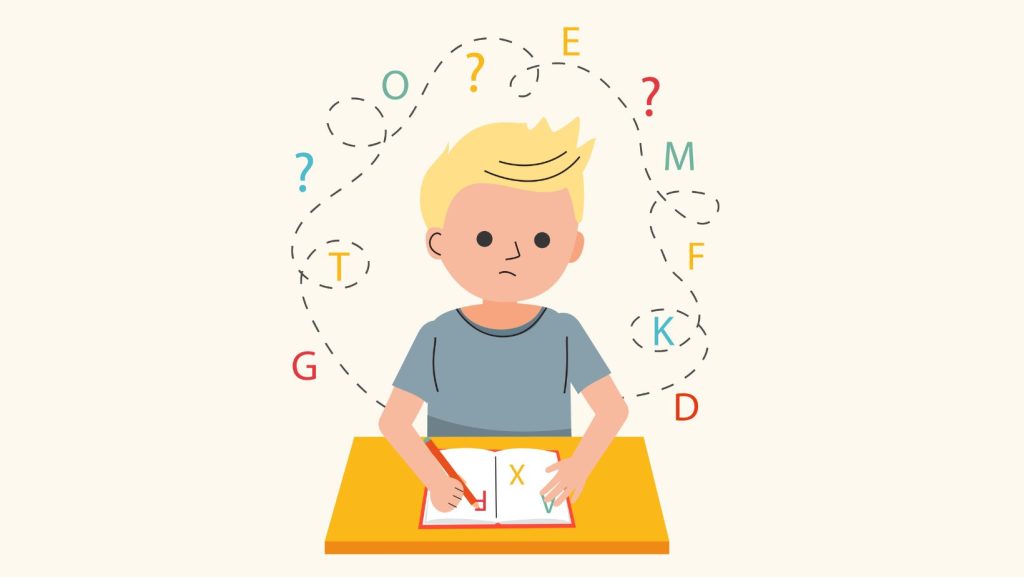
If your child is working hard, trying their best, but still struggling to read, you may be wondering whether something more is going on. Could it be dyslexia? The most common learning disability in the world, dyslexia is estimated to affect between 5 and 20 percent of the population, and many children go unidentified for years simply because parents and educators aren’t sure what to look for.
Dyslexia is a neurological learning disability characterized by difficulties with accurate and fluent word recognition, poor spelling, and weak decoding (the ability to sound out unfamiliar words by connecting letters to their sounds). It exists on a spectrum, is unrelated to intelligence, and has nothing to do with effort. Many children with dyslexia are bright, curious, and verbally articulate, and the gap between their evident ability and their reading performance is one of the most telling signs.
Early identification makes an enormous difference. Research consistently shows that children identified before age 7 respond significantly better to targeted intervention. Here are ten signs that your child may have dyslexia.
1. Difficulty rhyming and playing with sounds
Before children learn to read, they develop phonological awareness, the ability to hear and manipulate the individual sounds within spoken words. Children with dyslexia often have difficulty recognizing rhymes, completing nursery rhymes, or clapping out syllables. If your preschooler or kindergartner finds it persistently hard to identify words that rhyme or to play with sounds (“What word starts with the same sound as ‘cat’?”), this is an early and important red flag.
2. Trouble learning letter names and their sounds
Most children learn the alphabet song easily but may struggle to connect letter names with the sounds those letters make. Children with dyslexia often have persistent difficulty associating letters with their sounds, even with repeated instruction. This disconnect between the symbol on the page and the sound it represents is at the core of dyslexia.
3. Slow to add new words to their vocabulary
Children with dyslexia often take longer to acquire new vocabulary words or to retrieve words they know when speaking. They may pause frequently, use filler phrases (“that thing” or “you know”), or describe an object rather than naming it directly. This difficulty with word-finding and rapid verbal retrieval is closely linked to the phonological processing challenges underlying dyslexia.
4. Reading significantly below grade level
Once formal reading instruction begins, a child with dyslexia will typically read well below their expected level for age. They may struggle to sound out even simple, decodable words, frequently confuse letters with similar appearances (b/d, p/q), and read haltingly even with familiar words. If your child’s teacher has expressed concern about reading progress, take it seriously and request a formal assessment.
5. Slow, effortful reading that doesn’t improve predictably
Reading should become faster and more automatic as a child progresses through school. For children with dyslexia, reading remains slow and laborious even after considerable practice. They may read a passage haltingly, lose their place frequently, and need to re-read to understand what they’ve just decoded. By the time they reach the end of a sentence, the effort of decoding has consumed so much cognitive energy that comprehension suffers.
6. Avoidance of reading aloud
Many children with dyslexia develop acute anxiety around reading aloud. They may refuse, make excuses, cry before school, or claim to feel unwell on days when they know reading aloud is expected. This avoidance is not defiance; it’s a coping response to the real distress of struggling publicly with a task that their classmates perform with apparent ease. Pay attention to a child who consistently resists reading aloud, especially when their spoken language skills seem strong.
7. Persistent and unpredictable spelling difficulties
Poor spelling that doesn’t improve with instruction is a hallmark of dyslexia. Unlike typical spellers, children with dyslexia may spell the same word differently within a single piece of writing, rely heavily on phonetically plausible but incorrect attempts (such as “wuz” for “was” or “thay” for “they”), and struggle with high-frequency sight words that other children quickly memorize. Spelling and reading draw on the same underlying phonological skills, and weakness in one typically accompanies weakness in the other.
8. Verbal ability that sharply contrasts with written language skills
One of the most telling signs of dyslexia (sometimes dismissed as laziness) is the disconnect between oral and written language. A child with dyslexia may tell elaborate, well-structured stories, hold sophisticated conversations, and demonstrate impressive general knowledge, yet produce written work that is brief, laboured, and far below what you would expect based on their spoken communication. This gap is significant and warrants attention.
9. Rapid fatigue during reading or writing tasks
Because decoding requires so much sustained cognitive effort for children with dyslexia, reading and writing tasks are genuinely exhausting for them in a way other children don’t experience. Your child may seem fine in the morning but depleted by the afternoon, complain of headaches after reading, or be noticeably more fatigued than their siblings on days with heavy literacy demands. This is not a character issue; it reflects the tremendous neurological effort being made.
10. Difficulty in older students: summarizing, note-taking, and second languages
In secondary school, dyslexia often manifests through challenges that go beyond basic reading. Older students may struggle to summarize what they’ve read, take legible notes at speed, or acquire a second language. The phonological processing difficulties underlying dyslexia make it harder to hold and manipulate sound patterns in working memory, a skill essential to both note-taking and language acquisition. A teenager who has always seemed “slow” at these tasks may have had undiagnosed dyslexia throughout their schooling.
What to Do If You Recognize These Signs
If several of these signs are familiar, the most important step you can take is to pursue a formal assessment. A formal diagnosis is made by a registered psychologist or speech-language pathologist and will evaluate phonological awareness, phonological memory, rapid automatized naming (how fast your child can retrieve and say the name of something they already know), single-word reading, spelling, reading fluency, and comprehension. Begin by speaking with your child’s teacher and requesting a referral.
Remember: Dyslexia has a strong genetic component, which means early intervention does not just improve reading—research shows it can build new neural pathways and change the brain’s response to written language. Early action pays off.
At Evoke Learning, our reading tutors offer structured, systematic, and individualized instruction grounded in the science of reading. We work with students from Grade 1 through postsecondary, building the decoding skills, fluency, and confidence they need to succeed. If you have questions about your child or would like to learn more about our reading support programs, we’d love to hear from you.
Contact us at [email protected] or give us a call at 833-567-3544.