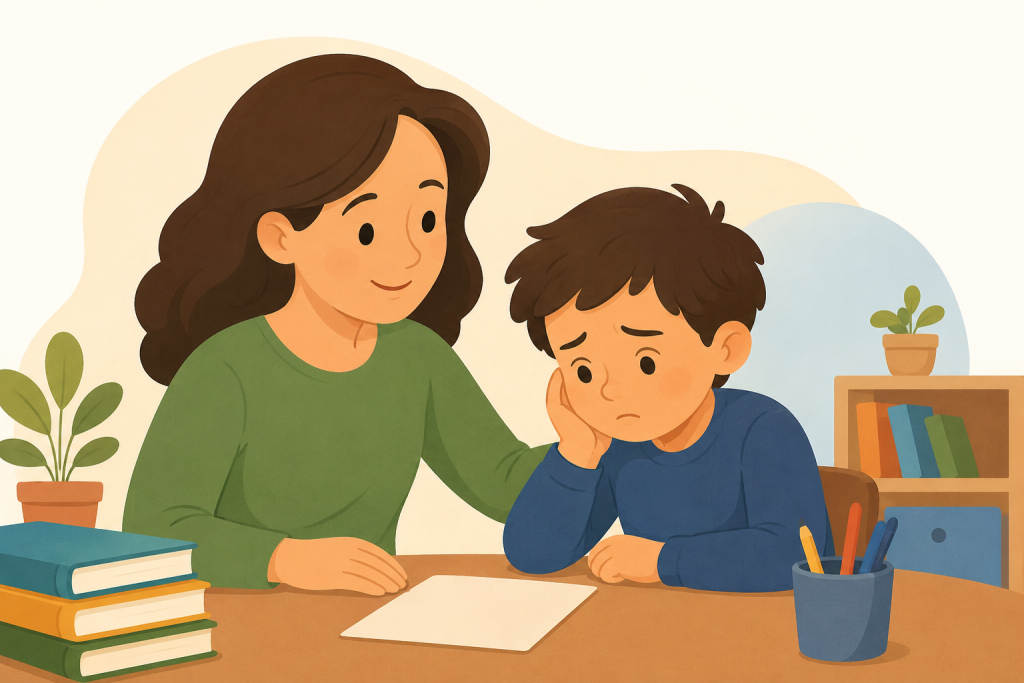
When a student is struggling emotionally at school—withdrawn, avoidant, convinced they are stupid or worthless—it’s tempting to focus on the emotions themselves. But low self-esteem is almost never the root of the problem. Behaviours like these are almost always a response to something. And until we can uncover what that something is, all the confidence-building in the world will only skim the surface of what is needed.
Begin with the Barrier
In most cases, a student’s low self-esteem is a direct reaction to a learning barrier they have not been able to name, get help with, or understand. That barrier might be an attention difficulty that makes it nearly impossible to follow a lesson. It might be an unidentified reading challenge that means every page of text is a struggle. It could be a specific gap in mathematical understanding that has been quietly compounding for years. Whatever it is, the student encounters it day after day, and without support, they blame themselves.
This is why emotional distress in students should be understood as a message, not a character flaw. The anxiety, shutting down, and refusal to try are not problems in themselves. They are a student’s best attempt to cope with something genuinely difficult. Our job is to find out what that challenge is.
The Cognitive Triangle: Thoughts, Feelings, and Behaviour
To understand what is happening for a struggling student, it helps to think about the cognitive triangle: the interconnected relationship between thoughts, feelings, and behaviour. These three elements form a cycle, and each one reinforces the others.
A student who has repeatedly failed to read aloud without errors begins to think, “I am bad at reading. I am not as smart as everyone else.” That thought produces a feeling—shame, dread, anxiety. That feeling then drives behaviour: The student avoids reading tasks, refuses to participate, or acts out before they can be put in a situation where they might fail. And that avoidant behaviour confirms the original thought, because they never get the practice or support that would actually help.
Emotion drives action and action reinforces the thought that started it all. This is why addressing the behaviour alone—pushing harder, applying consequences, expecting more effort—will not break the cycle. You must go further back and find the barrier.
Pulling Back the Layers
When a student presents with low self-esteem, avoidance, or emotional dysregulation at school, the question we should be asking isn’t “How do we make them feel better about themselves?” It is: “What is getting in the way for this child? What do they find difficult, and how can we make it easier?”
This requires a willingness to dig past the surface behaviour to understand the experience underneath. A child who refuses to write may not be defiant; they may be experiencing significant fine motor difficulty, or struggling to organize their thoughts into language, or unable to hold spelling patterns in working memory. A child who appears disengaged in class may not be indifferent, they may simply be unable to follow what is happening because attentional or processing difficulties are making the input inaccessible.
Every emotional and behavioural pattern a struggling student displays is a clue. The role of parents and educators is to be curious, not frustrated.
Ask the Student
One of the most powerful and underused ways to uncover a student’s barriers is also the simplest: asking them. Not in a pressured, problem-solving way, but with genuine curiosity and no agenda. “What part of school do you find hardest?” “What does it feel like when you are trying to read?” “Is there anything that would make it easier?”
Even young students will have significant insight into their own experience. They know when something feels impossible and when they are only pretending to understand. What they often lack is the language to describe it, and the trust that an adult will actually listen without judgment. When they are given that space, the information they offer can be transformative.
What This Looks Like in Practice
Identifying the barrier is just the beginning. Once we understand what’s getting in the way—whether through careful observation, direct conversation with the student, or formal assessment—we can begin to close the gap. This might mean targeted remediation, strategies to support attention and working memory, modified learning tasks, or assistive tools that reduce the cognitive load of areas of genuine difficulty.
As the barrier becomes smaller and more manageable, the student begins to experience competence. They start to gather evidence that contradicts the story they have been telling themselves. The thought “I can’t do this” is slowly replaced, not through affirmation, but through actual experience, with “I can do this, with the right support.” This leads to stronger self-esteem.
Signs That a Barrier May Be at the Root
Some indicators that a student’s emotional difficulties may be driven by an unidentified learning barrier include:
- Avoidance of specific tasks (reading aloud, writing, timed activities) rather than general disengagement
- Significant effort with little result, leading to frustration and giving up
- Inconsistent performance—capable in some areas, surprisingly stuck in others
- Strong verbal ability but difficulty producing written work
- Distractibility or apparent daydreaming, especially during language-heavy instruction
- Emotional outbursts that seem disproportionate, especially around schoolwork
- Negative self-talk that is very specific: “I’m terrible at reading” rather than “I’m bad at everything.”
Partnering with Parents
Helping a child who is struggling emotionally at school is not something parents should try to navigate alone. But it also should not begin and end with counselling or confidence-building exercises. The most caring question you can ask on behalf of your child is, “What is getting in the way?”
At Evoke Learning, our team takes a diagnostic, barrier-first approach to every student we work with, because we know that when the gap closes, the child changes. Not because we told them they were capable, but because they discovered it for themselves.
If you’re concerned about your child and would like to explore what might be getting in the way, reach out to us today for a free 20-minute consultation. We’re here to help.